Warwick Castle – Warwickshire
The history of Warwick Castle dates back to the Middle Ages. The foundation for the current structure was a wooden fort built in 1068. Over the centuries, it was expanded into the castle we know today. Throughout its long history, the castle has served many purposes, and today it is a major tourist attraction, drawing thousands of visitors every year. In 2001, it was named one of the UK’s top historic houses and monuments by the British Tourist Authority.
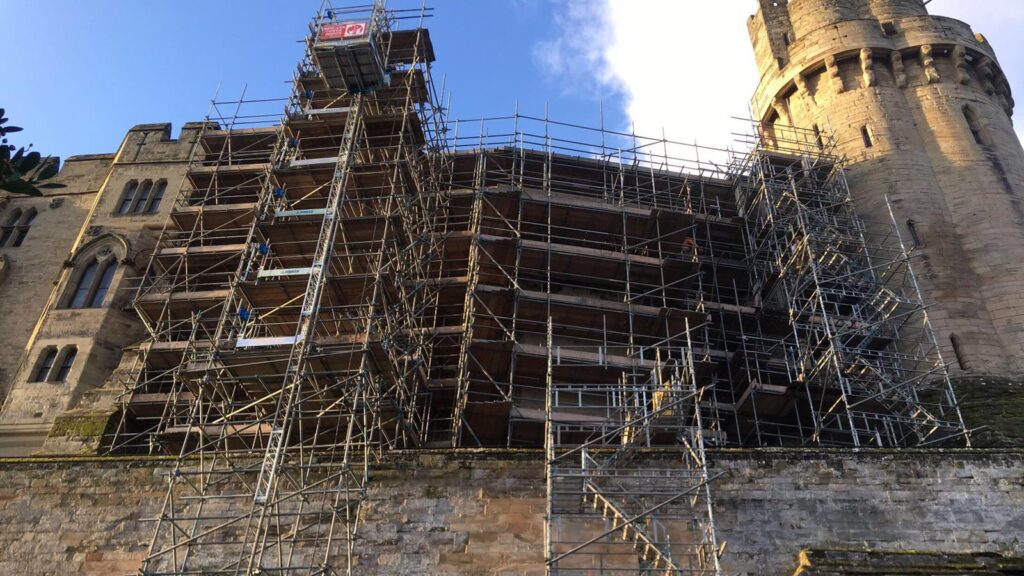
Warwick Castle is a Grade I listed building, meaning it is of exceptional national heritage importance. To preserve this piece of history, ongoing maintenance is essential. The company responsible for building the scaffold for the renovation of the castle’s stonework was Attridge Scaffolding.
Due to the sloping walls of the castle, designing and constructing the scaffold posed a significant challenge. Ultimately, Attridge Scaffolding found the ideal solution by using Van Thiel’s adjustable system transoms.
These system transoms feature an integrated extension arm that allows the scaffold to be fully adapted to the shape of the structure. The extension arm has a maximum span of three planks and can be adjusted steplessly to fit the required length.
Another advantage of Van Thiel’s system transoms is the ease with which the spacing between the standards can be set. The transoms are connected to the scaffold’s ledgers using two wedge couplers — a faster and more efficient alternative to bolt couplers. Wedge couplers can be installed using only 1 to 3 strikes with a scaffold hammer.
In addition to system transoms, Tube-Lock® tubes were also used in the construction of the scaffold. Thanks to the Tube-Lock® system, tubes can be connected quickly and easily without the need for welded couplers or tools. The connection is made with a simple twisting motion.

Van Thiel United B.V.
Bosscheweg 38
5741 SX Beek en Donk
NL009094933B01

